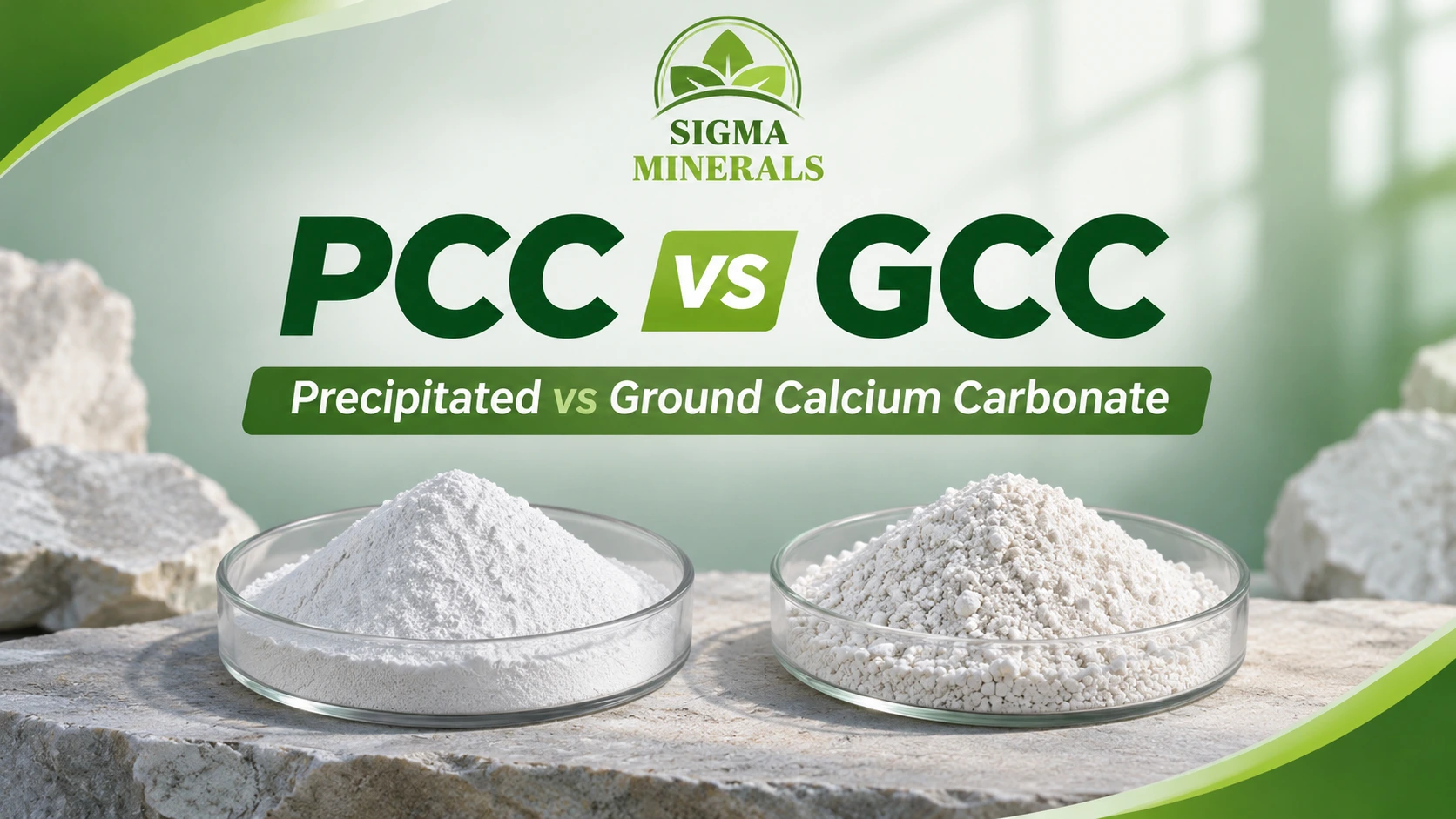
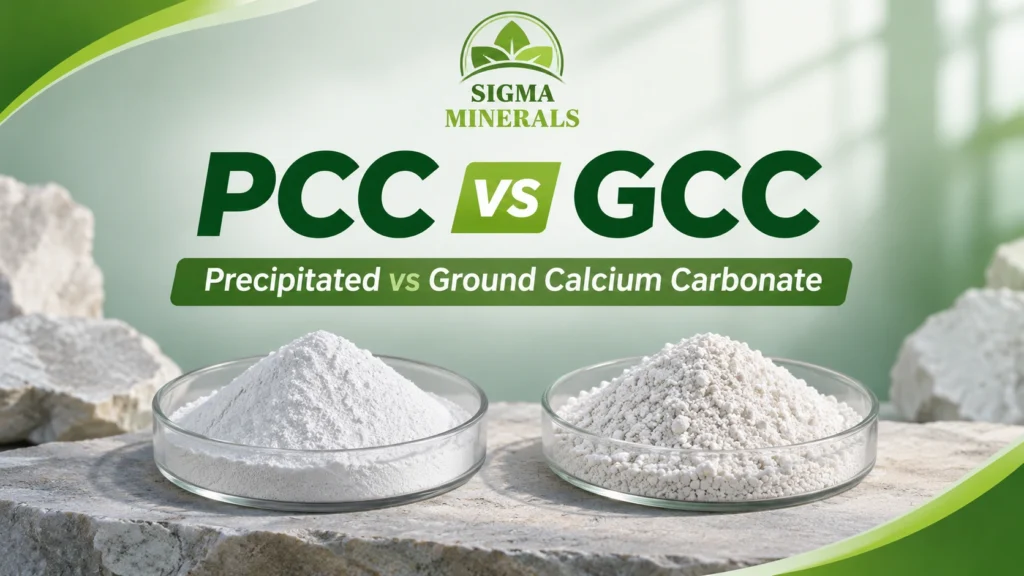
Quick answer: PCC (precipitated calcium carbonate) and GCC (ground calcium carbonate) are both CaCO3, but they are made differently. GCC is natural limestone, marble or calcite that has been crushed and ground. PCC is made by a chemical process, which gives finer, purer particles of a controlled shape. GCC is cheaper and used in far greater volumes. PCC costs more and is chosen when brightness, particle size or purity is critical.
Paper mills in Uttar Pradesh, Punjab and Haryana, PVC and plastics units in Gujarat and Telangana, and paint makers across India all ask the same question: is PCC worth the extra cost over GCC? This guide answers it.
What is GCC (ground calcium carbonate)?
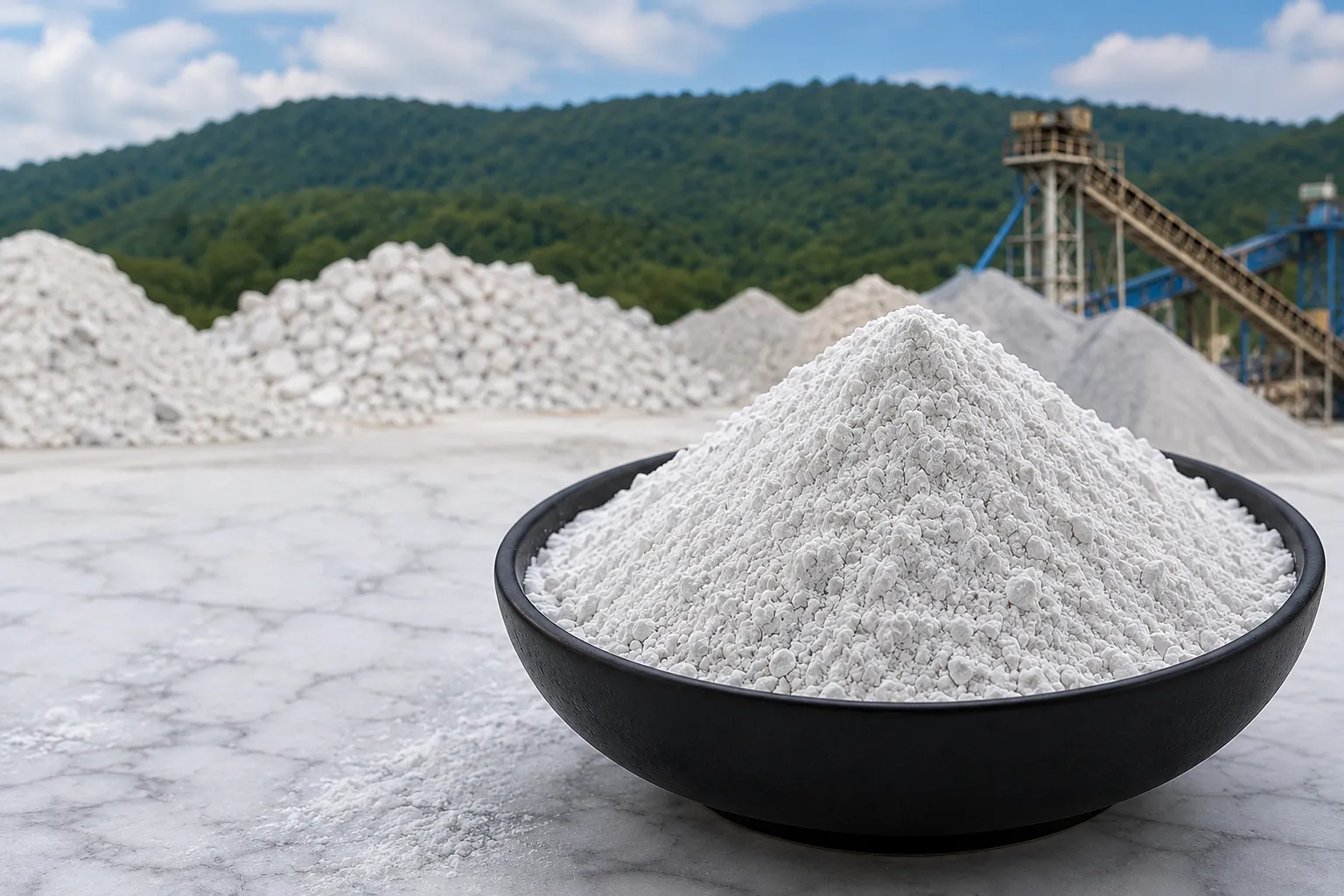
GCC is made by mechanical processing alone. Limestone, marble or chalk is quarried, crushed, ground and then classified by particle size. Nothing changes chemically. The quality of GCC therefore depends on the purity and whiteness of the rock it comes from. In India, much of it comes from calcite and marble deposits in Rajasthan.
What is PCC (precipitated calcium carbonate)?
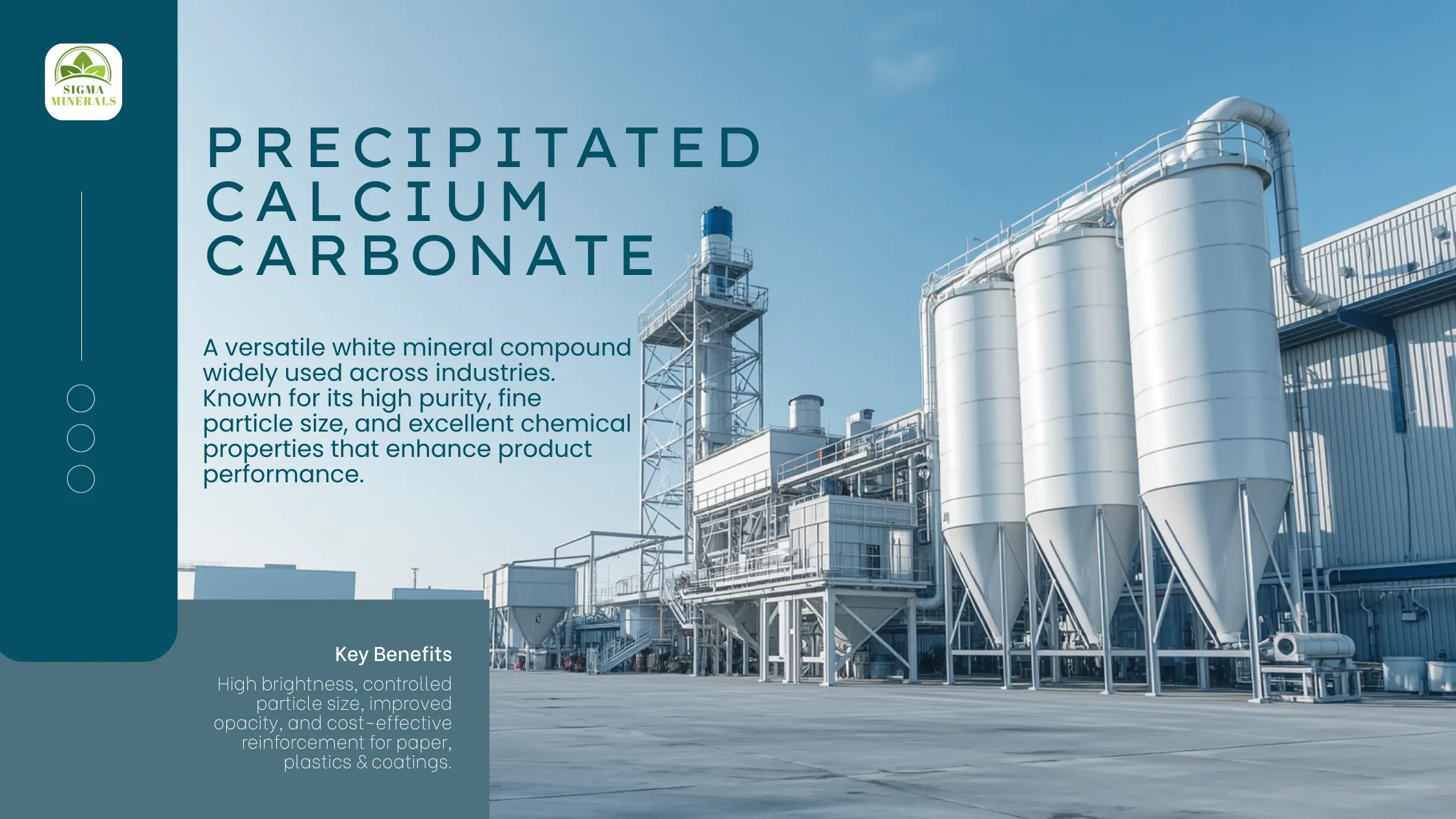
PCC is made synthetically. Limestone is burned (calcined) into quicklime (CaO). The quicklime is slaked with water into milk of lime, Ca(OH)2. Carbon dioxide is then bubbled through it, and fine calcium carbonate crystals precipitate out. Because the reaction is controlled, the manufacturer can set the particle size, the crystal shape and the purity.
PCC vs GCC: side-by-side comparison
| Property | GCC (ground) | PCC (precipitated) |
|---|---|---|
| How it is made | Crushing and grinding natural rock | Chemical precipitation from lime and CO2 |
| Typical particle size | About 1–45 microns | Sub-micron to a few microns |
| Particle shape | Irregular, broad distribution | Uniform: scalenohedral, rhombohedral, prismatic and others |
| Purity | Depends on the ore; may carry silica and other impurities | High and consistent |
| Brightness | Good (depends on the ore) | Very high |
| Oil absorption | Low | Higher (more surface area) |
| Cost | Lower | Higher |
| Volume used | Much larger | Smaller, specialty uses |
These are typical ranges. Check each grade’s technical data sheet.
Where GCC works best
- Paint and putty: extender in emulsions, distempers and wall putty, where cost per litre matters.
- PVC pipes and profiles: filler that cuts resin cost, often in coated grades.
- Plastics masterbatch: filler masterbatch for films and moulded goods.
- Construction: tile adhesives, sealants and dry-mix mortars.
- Cattle feed and agriculture: calcium supplement and soil conditioner.
Where PCC is worth the extra cost
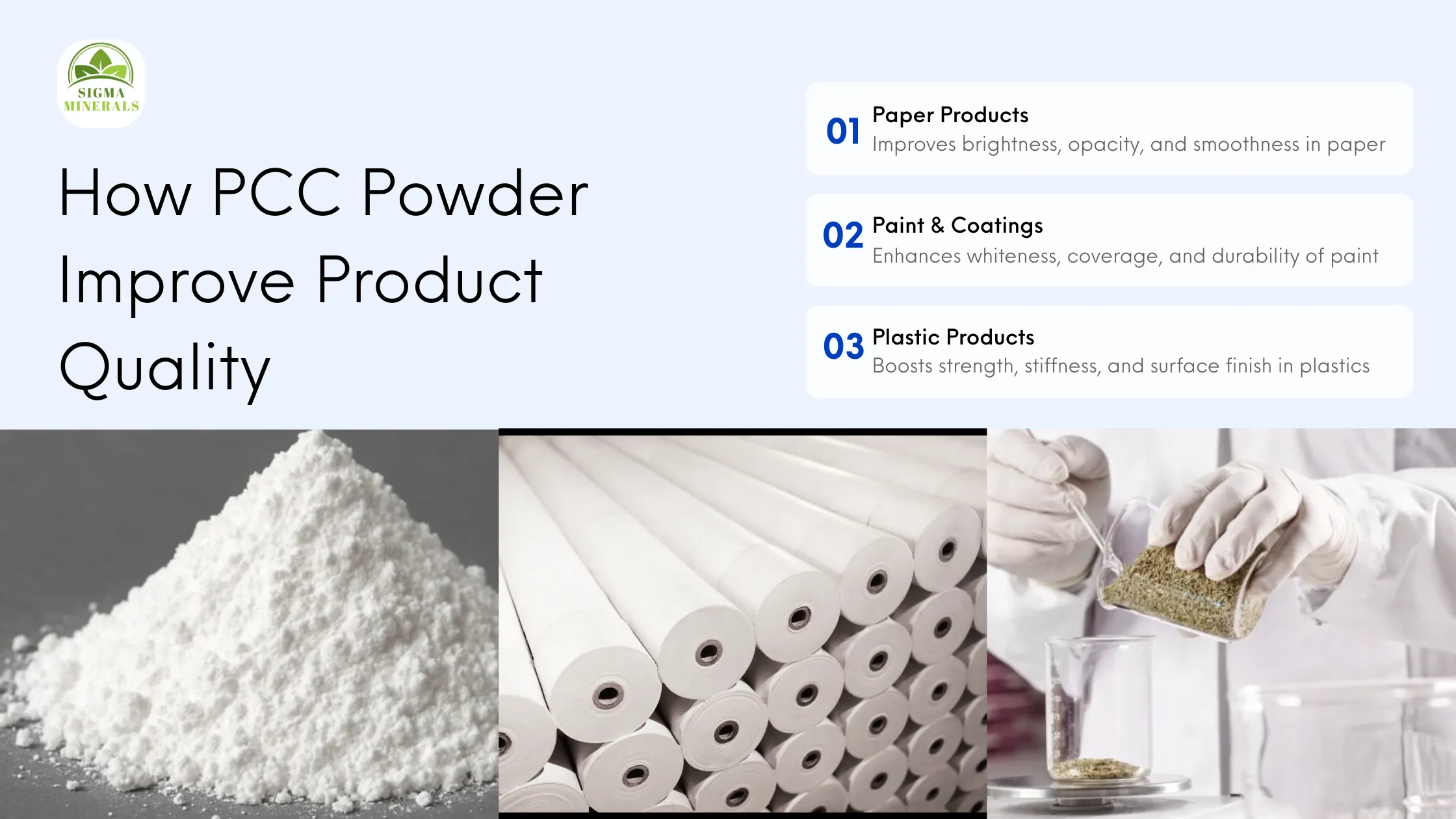
- Paper: PCC improves brightness, opacity and bulk. This is why paper clusters such as Muzaffarnagar–Meerut in Uttar Pradesh and the mills in Punjab and Haryana use it.
- Rigid PVC and sealants: ultrafine or coated PCC improves impact strength, surface finish and flow.
- Rubber: PCC works as a semi-reinforcing filler in footwear and technical rubber goods.
- Pharma, food and toothpaste: high-purity PCC grades that meet IP/BP specifications.
- Premium paints: PCC improves sheen control and opacity.
How to choose: a simple rule
- Start with GCC if your product only needs bulk filling and cost control.
- Move to PCC if you need high brightness, fine and uniform particles, better opacity in paper or paint, or pharma-grade purity.
- Blend both if you want a balance of cost and performance. Many paint and paper makers use a GCC + PCC mix.
- Always run a trial with your own formulation and compare cost per finished unit, not cost per kg.
What buyers in different regions usually ask for
- Uttar Pradesh, Punjab and Haryana: paper-grade PCC for brightness, plus GCC for PVC pipes and paint.
- Gujarat and Telangana: coated GCC for PVC and plastics, and ultrafine PCC for pharma and sealants.
- Bihar, West Bengal, Jharkhand and Odisha: GCC for putty, paint and detergents, and PCC for paper and rubber.
- Madhya Pradesh: GCC for PVC and putty units around Indore and Pithampur.
Common buying mistakes
- Comparing GCC and PCC on price per kg alone. PCC’s lower dosage or better results can change the maths.
- Ignoring moisture and particle-size distribution on the COA.
- Buying “calcium carbonate” without saying whether you need ground or precipitated, coated or uncoated.
Buy GCC and PCC from Sigma Minerals
Sigma Minerals India supplies ground calcium carbonate (GCC) and precipitated calcium carbonate (PCC) from Rajgarh (Alwar), Rajasthan. We dispatch to buyers in Uttar Pradesh, Punjab, Haryana, Bihar, West Bengal, Jharkhand, Odisha, Madhya Pradesh, Telangana and across India. Share your application, and we will suggest a grade and send a sample with its COA.
Frequently asked questions
Q1. What is the main difference between PCC and GCC?
GCC is natural rock ground into powder. PCC is made chemically from lime and CO2, so its particles are finer, purer and more uniform.
Q2. Is PCC better than GCC?
Not always. PCC performs better where brightness, opacity or purity matter. GCC is more cost-effective for bulk filling in paint, PVC and putty.
Q3. Why is PCC more expensive than GCC?
PCC needs calcining, slaking and carbonation, which use energy and control steps. GCC only needs grinding and classification.
Q4. Which calcium carbonate is used in paper?
Paper mills use both. PCC is preferred where brightness and opacity matter, and GCC where cost matters more. Many mills blend them.
Q5. Which calcium carbonate is best for PVC pipes?
Coated GCC is the common choice for PVC pipes because of its cost. Ultrafine or coated PCC is used in rigid PVC profiles that need better impact strength and finish.
Q6. Is precipitated calcium carbonate safe?
Pharma and food grades of PCC are used as calcium supplements and excipients. Industrial grades are for industrial use only. Always check the grade’s MSDS.
Q7. What does “coated calcium carbonate” mean?
Coated (activated) calcium carbonate has a thin stearic-acid coating. This makes it disperse better in plastics and rubber.
Q8. Can I replace PCC with GCC to save cost?
Sometimes, partly. Run a trial and compare the cost per finished product, because you may need a higher GCC dosage.
Q9. What is the chemical formula of PCC and GCC?
Both are CaCO3. The difference is in how they are made and in their physical properties.
Q10. Does Sigma Minerals supply both PCC and GCC?
Yes. Sigma Minerals supplies both from Rajasthan to buyers across India, with samples and COAs on request.